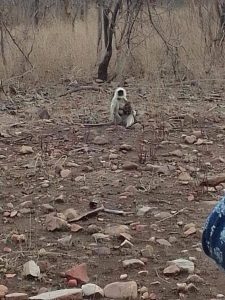
“Yawal Wildlife Sanctuary[1]”, Raver, Jalgaon is located close at the banks of Anner and Manjar Rivers and at the border of Madhya Pradesh. Its area is 176 Square Kilometers[2]. The area is protected by law[3]. A Dam is constructed on Suki River which lies in the center of wild life sanctuary. The Yaval Wild Life Sanctuary is home to a significant natural diversity of fauna most notable the Bengal Tiger[4]. Other wild animals include Blue Bull; Spotted Dears; Wild Dogs; Leopards, Spotted Dears, Peacocks, Flying Squirrels and many other types of wild birds.
Forest is not very dense but economically important trees of Mahua (Madhuca indica), Salai (Boswellia errata); Dhawada (Anogeisus latifolia) are found in great number.
This area is classified as IUCN Category IV[5] protected areas; as of March 2025, this wildlife Sanctuary is duly enlisted; it encompasses special attention to be taken to avail basic facilities to wild flora and fauna; extra vigilance is also framed to check human activities in the specified area.[6] Conservators are not allowed to develop or promote any stressful situation for the biota, duly enlisted as animals and plants to be protected by law.[7]
Advisory
After observing the situation it is recommended that conservation of animals and plants by law may not attain adequate eve of success without ensuring active participation of different active members of different communities living in or around the operational area. Legal framework duly enacted under the Wildlife Conservation Act is not encompassing adequate scope of participation of people in any sort of joint initiatives. Recommendations listed in Joint Forest Management Strategy, or in Social Forestry Schemes, is also not accommodating any kind of sectoral coordination’s to let people work jointly to protect animals and plants.
Only Government initiative, without ensuring active participation of people, may not ensure effective implementation of the conservation strategy, for which we have different bands of law enforcement.
Participation of different Development Organisations working in and around the locality may work as catalyzing agents to ensure effective pitching of the law enforcement initiatives.
[1] This Wildlife Sanctuary is situated at the banks of river Anner and Manjer; a place adjacent to Madhya Pradesh Border. Reference: “Places to Visit in Yawal | Tourist Places, Sightseeing Points around Yawal | Maharashtra Planet”. MaharashtraPlanet.com. Retrieved 18 May 2022.
[2] This area of dense forest is protected by law since 1969. Ref : “Yawal Wildlife Sanctuary – Resurgence Through People’s Participation”. Radical Ecological Democracy. 28 October 2017. Retrieved 18 May 2022.
[3] Protection strategy duly implemented by Govt. of India, supplemented with Wildlife Protection Act is one of the fruitful initiatives which declare hunting, poaching, killing or disturbing wild animals by any other means is declared as a punishable offence. Refer: “What is the difference between Wildlife Sanctuaries and National Parks”. India Today. 24 September 2020. Archived from the original on 25 July 2021. Retrieved 25 July 2021.
[4] “Yawal Wildlife Sanctuary – Resurgence Through People’s Participation”. Radical Ecological Democracy. 28 October 2017. Retrieved 18 May 2022.
[5] IUCN protected area categories, or IUCN protected area management categories, are categories used to classify protected areas in a system developed by the International Union for Conservation of Nature (IUCN).
[6] It is expected that animals living in a protected area along with other naturally growing plants should not be disturbed by any means, specifically due to human interventions, or by any other un-authorized human activities. Ref: Tom Regan (2006). Jaulas Vacías. El Desafío de los Derechos de los Animals (in Spanish). Barcelona: Fundación Altarriba. p. 111. ISBN 978-84-611-0672-1
[7] “Why should sanctuaries and researchers collaborate?”. Why Sanctuaries?. Duke University. Retrieved 14 September 2026.